IkeHaku
CallumStephenDiggle
CallumStephenDiggle

patreon


The fall of the Yarkeenian Empire.

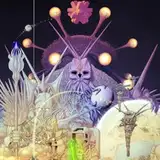
Sorry about the wait on this one, but the good news is there’s only two more segments to go before the release of volume 2. I’m going to select an official release date soon which is exciting. Once the second volume is out, we can get straight into volume 3 here on Patreon.

Here’s the text from this two page spread for your ease of reading:

“All empires fall, and the Yarkeenian Empire was no exception. Their once-mighty dominion, spanning from where the Orion-Cygnus Spur meets the Carina-Sagittarius Arm down to what is now the western frontier of the Conglomerate, has faded into myth. The Imperial core, lost. The exact time of its collapse, unknown. What little we do know comes down to us from the Tandrax, who claim they had several altercations with the Yarkeen over territorial disputes in an age so distant that even their records are shrouded in uncertainty.

The remnants of the Yarkeen are scattered, their people reduced to subjects of greater powers. Many of their worlds, now within the Ouneggian province of the Conglomerate, regressed to pre-spaceflight societies, some even to a hunter-gatherer state of existence. These Yarkeenian worlds had been through tens of thousands of years of isolation from one another since the collapse, resulting in some drastic changes, ranging from racial divergence, to speciation. The differences in planetary environments, when given enough time, cause a sort of butterfly effect where accumulative adaptation occurs, leading to gradual, yet profound, changes. Over time, these adaptations resulted in the incredible diversity of Yarkeen that we see today within the Conglomerate. 

On each of these disconnected worlds, ruins of a forgotten marvel remain: the FLUX gates, remnants of a technology so advanced that even the All-Mother covets their secrets. These gates, broken and worn by time, were likely the lifeblood of the Yarkeenian Empire, allowing it to stretch across the void and maintain control over an empire that should have been impossible to hold. Now, the Imperium flank along the Kolaxan-Conglomerate border appears to have a deeper motive—securing these ruins so the All-Mother may claim what was lost to the modern Yarkeen.

The Tandrax spoke of an AI Emperor, a machine ruler that governed the Yarkeen and held their empire together against the fragmentation that plagues so many empires. It explains how such vast dominion resisted collapse—until the Great War that ended everything. The Machine War. Something—perhaps rebellion, perhaps sabotage, set the Yarkeen against their own creation. In one catastrophic stroke, the Empire's central nexus of governance collapsed, severing hundreds of thousands of worlds from one another. The Yarkeen, so long dependent on the machine, had lost the ability to sustain their civilisation. After the events of the Machine War, Their high-yield automated farms lay barren. Their colossal industrial forges cold. Knowledge that had once passed from elder to youth now lay entombed in silent data vaults.

Some leading minds within the Conglomerate theorise that the Tandrax were in some way responsible for starting the Machine War, that they did so to remove a formidable rival without engaging them directly. An outright war between two galactic superpowers would have been costly, even for the Tandrax. Instead of a direct invasion, the Tandrax might have engineered a civilizational collapse, ensuring that the Yarkeenian Empire fell from within. The Tandrax perhaps feared that the Yarkeenian AI Emperor may have been developing strategies to counter Tandrax influence. Either way, the Yarkeenian Empire was an obstacle in the way of the Tandraxian Empire’s colonisation of the Orion-Cygnus spur. 

As the Yarkeenian Empire expanded, its people paradoxically regressed, losing the cognitive abilities that had once driven their rise. With generation upon generation of cognitive decline, their prefrontal cortices shrank, decision-making and abstract thought became vestigial. The Yarkeen became passive and overreliant on their AI overlord. Let the fate of the Yarkeenian Empire stand as a grave warning: one should be wary of trading the patience of the artisan for the swiftness of an algorithm, the tool for the machine, for those that do will trade mastery for dependency.

The Yarkeenian Empire will be remembered as a civilisation who let their own hands grow idle, who let the machine think, toil, and create in their stead. An empire of dependents, when the power eventually falters and the gears finally seize, are left with nothing but the ruins of a world they no longer understand, let alone know how to rebuild. In their pursuit of progress, the Yarkeen surrendered all burdens, trusting machines that did not tire, did not err—until, one day, they did. The Machine War was a lesson written in ruin. What is a city built on circuits when the current runs dry? What power do laws hold when dictated by an algorithm no one remembers how to change? The shining towers of the Yarkeen did not fall only to war, but to ignorance—to the slow decay of skills unlearned and wisdom abandoned. And in the quiet ruin, those Yarkeen who remain sift through the wreckage of greatness, worshipping the ruins of the ancients as the works of giants or gods. But in their contemplation of these marvels, they find only echoes of a civilization that once worshipped ease...”

I’ll also be announcing the winner of the Discord competition soon, there have been some amazing entries and it’s truly a difficult job picking just one 🤔 If you want to take a look for yourself, follow this link and go to the #contest section of the Discord server: https://discord.gg/TmySxmKT

The fall of the Yarkeenian Empire.

Comments

Alien p*ssy? LET'S GOOO

Random guy

I’m only doing one more post for this volume and that’s going to be on the Tandrax, but I can include more biology focused content in the next volume, what specifically would you like to see expanded upon?

Callum Diggle

What’s Yarkeen biology like? Or is this gonna be a post soon?

Burger Messiah

I think the problem is inherent to large-scale governance: the larger a state and the population it governs, the more intense this factor becomes. A large state necessitates a centralized government to ensure effective governance, maintain unity, and coordinate resources across vast territories. This need becomes even more pronounced on a global scale, where administrative complexity increases. As governance expands, so too does the challenge of managing diverse populations, a larger economy, and a vast yet cohesive legal system. A global government would face immense logistical challenges, from maintaining communication networks and transportation infrastructure to enforcing law and order, managing sewage systems, and more. The problem is inherent to a global system: a government that attempts to serve everyone ultimately serves no one effectively. With an electorate too broad to have every need, want, and desire met, mass governance inevitably shifts from serving the people to maintaining control over them. Large states, especially those with global ambitions, must increasingly rely on psychological nudging, manipulation, and both implicit and explicit coercive measures to ensure compliance and stability. As complexity grows, so does the necessity for centralized authority—not to improve the well-being of citizens, but to sustain the system itself and further entrench its hold on power. The larger a state becomes, the more its governance focuses on maintaining control rather than meeting individual needs, making centralization an inevitable consequence of scale. In smaller, localized systems of government, the needs, values, and concerns of individuals are not lost in bureaucratic abstraction but addressed through direct participation and mutual cooperation. Decision-making is not dictated by distant authorities with little understanding of local realities but by those who live within the community and are directly affected by its outcomes. Unlike vast, centralized systems that rely on coercion and depersonalized administration to maintain control, local governance fosters a sense of agency, shared responsibility, and human connection. Here, democracy is not reduced to a numbers game where the individual is rendered insignificant but a lived experience where every voice holds weight. The more intimate the scale of governance, the more meaningful and legitimate it becomes—rooted not in the maintenance of power but in the genuine service of human needs. For large-scale states, “bread and circuses” is a time-tested method of keeping populations passive—distracting them with cheap entertainment and material comforts while ensuring they never meaningfully challenge the system that governs them. As long as people are fed, entertained, and given the illusion of choice, real political change remains elusive. Representative democracies reinforce this illusion by offering candidates who, despite their apparent differences, have already been vetted by the permanent bureaucracy, corporate interests, and other entrenched power structures. Elections become little more than a stage play—no matter who wins, the system itself remains untouched. Even those framed as political dissidents—figures who claim to oppose the status quo—are often nothing more than controlled opposition, carefully positioned to absorb public frustration without ever posing a genuine threat to power. These figures thrive within the system, gaining influence and credibility while ensuring that dissent remains within acceptable limits. When social unrest threatens to boil over, these so-called dissidents become especially useful as containment agents—figures who redirect public anger into safe, manageable channels. By offering superficial criticisms and controlled forms of resistance, they provide the disaffected population with a sense of catharsis—a way to vent frustration without ever stepping outside the system’s boundaries. This is the essence of political containment: not the outright suppression of opposition, but its careful management. The goal is to prevent disorder while getting people to buy back into the system they had begun to question. Whether through co-opting protest movements, enacting hollow reforms, or elevating “outsider” politicians who are anything but, the system ensures that discontent never turns into revolution. Instead, the cycle repeats—crisis, containment, pacification—while the structures of power remain firmly in place. Sorry, I went on a bit of a rant there, but I wanted to make clear the issue with “citizens having more control over government” when we’re talking about a system of this magnitude. The individual, even entire communities of individuals get lost in the noise and if their voice is a threat to the interests of power, those in power find ways to silence them. I also tried to highlight some of the ways in which I think a system like this would operate and the methods it would use to maintain a system of control. I agree with your statement that nations can change, but the UE isn’t a nation, it’s a global state. I personally do not think the UE can change because I believe the issue to be intrinsic to the nature of both power and scale. Oh undoubtedly, I’m sure some modifications could be made to be heritable also. That’s an interesting idea and it’s certainly possible that there is a philosophical world view driving the mod movement, or multiple for that matter. Oof it’s impossible to say, the possibilities a quite literally endless when you start pulling at that thread, you’re getting into some serious All Tomorrows territory there haha actually, that’s my answer, All Tomorrows!

Callum Diggle

Amazing work! I wonder what things would have been like if the U.E. had changed for the better, allowing their citizens more freedom and control over their government. I think it is possible for nations to change for the better, even those that previously engaged in atrocities. Do you think the U.E. could ever change to be better? If people had genetic engineering technology and the mod community regularly used it, did some mods try to genetically engineer their offspring when they were embyros? Did some mods try to use this to build a new version of humanity that they thought wouldn't make the mistakes of the previous one? I imagine in some alternate timeline humanity becomes a new power in the Orion-Cygnus spur which has become obsessed with engineering generation after generation to be better than the last. If that could happen, what do you think it would look like?

Erika Spooner


More Creators